

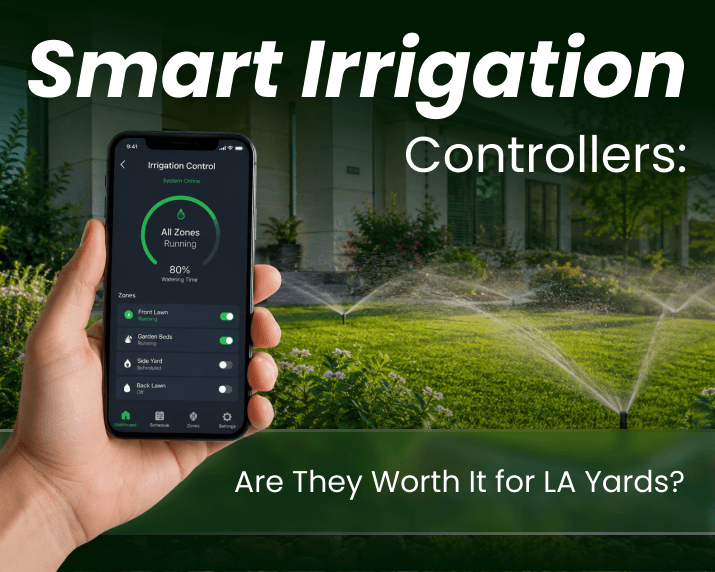
Most irrigation controllers do one thing: run on the schedule someone programmed into them. They water the lawn on Tuesday, Thursday, and Saturday whether it rained the night before or not. A heat spike doesn’t change them. Neither does a week of coastal marine layer that kept everything damp. The sprinklers run, and the water bill follows.
A smart irrigation controller doesn’t run a fixed clock. It pulls weather data from your zip code and adjusts each zone’s run time based on what’s actually going on outside that day. For LA yards specifically, where LADWP uses tiered water pricing, Southern California summers run long and dry, and late-season rain events can drop several inches in a single week, the case for upgrading is stronger than almost anywhere else in the country.
Here’s what a smart irrigation controller actually does, what it costs, what rebates are available through SoCal Water$mart, and where the investment makes sense and where it doesn’t.
What a Smart Irrigation Controller Does
Your current controller is a programmable clock. You tell it which zones to run, how long, and which days. After that it repeats indefinitely. Ninety-eight degrees in Encino that week? The schedule doesn’t care. Rained all week in the foothills? It runs anyway, and the water bill reflects it.
A smart controller replaces that clock with something that actually reads conditions. Most pull data from your zip code or a nearby weather station. What they’re tracking is evapotranspiration: the water your landscape loses through evaporation off the soil and uptake through the plants, calculated from heat, wind, humidity, and solar radiation. That number moves around a lot across a single LA week. When it’s hot and dry, the system runs longer. After a rain event, it skips the cycle. In cooler months it scales back on its own.
Two categories come up in this space. Weather-based irrigation controllers (WBICs) adjust run times on their own using real-time data and evapotranspiration calculations. This is the more capable type and the one that qualifies for EPA WaterSense certification. The term WiFi sprinkler controller covers any controller with wireless connectivity. Most modern weather-based controllers include both. The WiFi lets you monitor and adjust from your phone. The weather logic is what actually cuts the water use.
The upgrade itself is simpler than most people assume. Pull the old box off the wall, connect the new controller to the same wiring, and set it up through the app. Sprinkler heads, valves, and underground pipes stay exactly as they are.
Why the LA Climate Makes This Worth Considering
Most climates where smart controllers pay off share one thing: conditions change fast enough that a fixed schedule can’t keep up. LA is that climate about nine months out of the year.
Take a typical week in October. Mornings along the coast in Santa Monica and Culver City stay cool and marine-heavy, which keeps the soil wetter than you’d expect. Come afternoon in Arcadia or Azusa, east of the 605, evaporation rates can run twice as high as the coast that same day. Then a Santa Ana wind stretch pulls moisture out of the ground fast enough that a fixed schedule is already two days behind. And then it rains six inches over a weekend. A fixed timer runs through all of it at the same rate.
A smart controller reads the precipitation data and skips the cycles after the rain. During a heat spike it extends the schedule. Honestly, the seasonal timing issue is the one that catches the most LA homeowners off guard. Systems set up in spring for warm weather are still running those exact schedules in October, even as temperatures drop and the natural water demand drops with them. The stretch between summer and the first real rain is exactly where fixed-timer overwatering compounds the most.
Water pricing in LA makes all of this more expensive than it looks. LADWP uses tiered pricing, where each additional unit costs more than the previous one. A yard that’s slightly overwatered by a fixed schedule can push a household into a higher pricing tier, adding cost well beyond the water volume itself. And there are mandatory outdoor watering restrictions during declared water shortage conditions. A smart controller can be updated to comply automatically rather than requiring manual reprogramming every time the rules change.

How Much Water and Money Does a Smart Controller Save?
Roughly half of all household water in Southern California goes outdoors, according to the Metropolitan Water District. Weather-based controllers cut that outdoor portion by 20–50%, according to the EPA WaterSense program. In LA, where every unit over a certain threshold costs more than the last, those percentages translate to real dollar reductions.
For a typical LA property spending $120 per month on water, with half going to outdoor irrigation, that’s roughly $60 in monthly irrigation cost. A 30% reduction saves about $18 a month, or $215 per year. Most smart controllers sell for $100–$250 depending on zone count. At that savings rate, the hardware cost comes back in one to two years.
Those numbers hold up better on larger yards. A six-zone property in Burbank or Glendale with separate zones for lawn, shrubs, slope, and drip will generate meaningful savings fast enough to make the math obvious. A smaller Koreatown property with one grass zone and one drip circuit won’t generate the same volume and will take longer to recover the cost. Zone count and yard size are the two main variables.
Here’s a useful question: how many times in the last year did you manually change your controller’s schedule? For most people the honest answer is once, maybe never. That spring schedule from two or three years ago is probably still running. The gap between that fixed schedule and actual conditions is exactly where smart controllers recover the most water and cost. EPA WaterSense estimates that US homes waste nearly 9 billion gallons of water per day from irrigation inefficiency, much of it from fixed-timer systems running when conditions don’t call for watering.
LADWP and SoCal Water$mart Rebates
LA homeowners can offset the upfront cost through the SoCal Water$mart rebate program, administered by the Metropolitan Water District of Southern California. For properties under one acre, the current rebate is $80 per controller for EPA WaterSense certified smart irrigation controllers.
That $80 brings a $150–$180 controller down to $70–$100 before installation. Combined with the first year of water savings, most LA homeowners recover the full cost within twelve months.
To qualify, follow three steps:
- Choose an EPA WaterSense certified controller. Major residential brands including Rachio, Rain Bird, Hunter Hydrawise, and Orbit B-hyve all have qualifying models. Check the EPA WaterSense product list for specific model numbers, since certification applies to individual models within each brand, not the entire product line.
- Have the controller installed on an active irrigation system with working zones. The rebate covers controllers connected to in-use systems, not inactive or disconnected ones.
- Submit your rebate application through the SoCal Water$mart website after installation, with your receipt and proof of purchase.
Rebate amounts and program terms update periodically. Confirm the current details on the SoCal Water$mart website before purchasing.
What You Actually Use the App For
Every major smart controller ships with a smartphone app. The marketing leans hard on the “control your sprinklers from Hawaii” angle, which is real (you can do that), but it’s not what most people in LA actually use it for.
Skipping a cycle
comes up most often. Rain is in the forecast and you want to skip the next scheduled watering. You open the app and skip the cycle. It takes about ten seconds. Previously that meant walking to the garage and finding the panel that hadn’t been touched since a landscaper set it up years ago.
Testing individual zones
is also worth having on your phone. If you think a sprinkler head is broken or a zone isn’t running, you can trigger zones one at a time while standing in the yard, without needing anyone at the controller.
Monitoring water usage
gives you a running estimate of how much each zone consumes per cycle. If a zone suddenly shows double its usual usage, it typically means a broken head, a valve stuck open, or a line issue worth investigating before it runs up the bill.
Seasonal adjustments are the last regular use. Most people set spring schedules, let the weather logic handle summer without touching anything, and dial back to winter settings in November. That twice-a-year update takes about five minutes total. Everything in between, the system handles.
Zone-by-Zone Scheduling for Mixed LA Landscapes
A standard fixed timer runs every zone at whatever schedule someone set. A smart controller runs each zone based on what’s actually planted there. In LA, that difference matters more than almost anywhere.
Most controllers let you tell the system what each zone contains: warm-season turf, cool-season turf, ornamental shrubs, ground cover, or drip. The weather-adjustment logic then applies different calculations per zone based on plant type rather than a single uniform run time. A Pasadena or Glendale property with lawn in the back, ornamental shrubs along the side fence, a drip line for vegetables, and slope planting out front has four zones with four different water requirements. A fixed timer running them all on the same schedule is almost certainly getting at least two of them wrong.
When the controller knows a zone contains drip for ornamentals, it applies a different evapotranspiration adjustment than it would for turf. If you’re also thinking about converting a spray zone to drip, a smart controller handles both types independently once you update the zone settings. The drip irrigation vs sprinkler comparison is worth reading if you’re making that decision alongside a controller upgrade.
Will It Work With Your Existing System?
Most residential irrigation systems installed in LA after the mid-1980s use a standard 24V AC wiring configuration. Smart controllers use the same standard. The new controller connects to your existing zone wires, the same valves operate, and the sprinkler heads don’t change. You’re replacing the control box, not the system.
Before buying, find out whether your existing wiring has a C-wire. Smart controllers need it to stay connected to WiFi and pull weather data continuously. Older installs often skipped it entirely, since timer-only controllers never required continuous power. If yours is missing one, most brands include a workaround module that handles it without running new wire. A professional installer can also pull a new C-wire during the swap if you want a cleaner setup.
Count your active zones before buying anything. Most residential setups run eight or fewer, which any standard controller handles fine. Get into Bel Air, Pacific Palisades, or Malibu territory with 20-plus zones and you’re looking at a commercial-grade unit or two controllers wired in tandem.
The WiFi band question is the one that catches people off guard more than anything else on this list. Most smart controllers only connect on 2.4GHz. If your router only broadcasts on 5GHz, confirm compatibility before you commit to a purchase. And if your router runs both bands, labeling the 2.4GHz network separately before install day will save real hassle.
One thing that catches people on older LA properties is power. Most controllers plug into a standard 120V outlet nearby. But in Eagle Rock, Highland Park, or Silver Lake, utility rooms sometimes got improvised during the original irrigation install. A controller that’s hardwired with no outlet nearby is more common than people expect. Better to find that out before the installer shows up.
DIY Installation vs Professional Installation
Replacing an irrigation controller is one of the more manageable DIY projects for anyone comfortable with basic wiring. Five steps, in order:
- Photograph all the existing wiring before touching anything. You’ll want a clear reference for which wire goes to which zone.
- Label each wire with its zone number.
- Disconnect all wires from the old controller.
- Mount the new unit in the same spot.
- Reconnect each wire to the correct terminal, download the app, connect to WiFi, and work through the setup wizard.
Most people with a standard 6-8 zone setup and an existing C-wire wrap it up in under an hour. Every major brand includes setup guides and video walkthroughs.
That said, a few situations are better handled professionally. If the system has more than 8 zones, especially when some zones haven’t run recently and need to be tested first, DIY gets more complicated. If there’s no C-wire and adding one means opening a wall or running new wire, that’s a professional job. And if the existing system hasn’t been inspected in years, the controller upgrade and the system checkup are worth doing at the same time. A broken irrigation system with leaking valves or broken heads will lose more water through those failures than the smart controller saves through scheduling. Getting both handled on one visit avoids a second service call.

What to Look for When Choosing a Smart Controller
Start with EPA WaterSense certification. It qualifies you for the SoCal Water$mart rebate and means the weather-adjustment logic meets a tested efficiency standard. Check the EPA WaterSense landscaping resources for the current certified product list before buying. Certification applies to specific model numbers, not entire brand lines, so don’t assume a brand’s whole lineup qualifies because one model does.
Zone capacity
has to match your system. Count active zones before buying. An 8-zone controller covers most standard residential setups. A 16-zone model works for larger properties and gives room for future expansion without needing a second unit later.
Most LA installations go inside a garage or utility room, so indoor-rated models work fine. If your controller needs to mount outdoors, verify the IP weatherproof rating before purchasing. It’s one of those things people skip and then regret.
For WiFi compatibility, confirm your router broadcasts a 2.4GHz band. Most smart controllers don’t support 5GHz, and this is the single most common setup issue people run into after the controller is already mounted.
App quality
matters more in practice than spec sheets suggest. You’ll use the app at least twice a year for seasonal adjustments, and more often in the first few months. Rachio and Rain Bird have consistently well-reviewed apps with clear zone visualization. Reading recent app store reviews gives a more accurate picture of the current experience than any product page will.
If you already use Google Home, Amazon Alexa, or Apple HomeKit in your house, most major certified controllers support at least one of those platforms. It won’t change how the weather logic works, but triggering a zone by voice or fitting the controller into a broader home automation routine becomes possible. This is not a deciding factor, but worth knowing before you commit to a brand.
When a Smart Controller Probably Isn’t Worth It
Not every LA yard benefits enough to justify the cost, and it’s worth being honest about that.
Very small systems
don’t generate enough savings to justify the hardware. A property with one or two zones, like a small front lawn in Mar Vista or a single drip circuit for a container garden, won’t recover the cost within any reasonable timeline. A standard programmable timer with an add-on rain sensor is the more sensible option here.
Systems that need repairs first
should get those fixed before any new hardware goes in. A
malfunctioning sprinkler system
with broken heads, leaking valves, or clogged lines loses more water through those failures than a smart controller can save through better scheduling. You’d be adding efficiency technology on top of a system that’s still losing water somewhere.
Long-inactive systems
tell a different story than a standard upgrade. If the irrigation hasn’t run in several years, the controller is one small piece of a larger project. Zone testing, valve inspection, and a pressure check all come before any new hardware.
Rental properties
present a practical barrier. Without ownership of the property and system, the rebate application, installation decisions, and long-term savings all require property owner involvement. This isn’t a project most renters can manage independently.
How Elevated Seasons Approaches Smart Controller Upgrades
When a client contacts us about a smart irrigation controller through our irrigation services, the first thing we ask about is the condition of the existing system. An upgrade on a well-maintained system is a clean two-hour job. On a system that hasn’t seen a professional inspection in years, the controller is almost always the last recommendation, not the first.
For most LA properties built after 1990, the wiring is compatible and the valves are in working order. The job includes controller installation, app setup, zone configuration by plant type, and a zone-by-zone sprinkler test while we’re on site. When we find issues during that inspection (and on older systems, we usually do), we flag them before recommending any hardware purchase.
The sprinkler system installation cost page on our site covers what full system replacements look like when the existing infrastructure isn’t worth upgrading. In most cases though, the existing setup is fine and the smart controller swap is the right move.
to talk through a smart controller upgrade for your property. We’ll review your existing setup, tell you whether any repairs should come first, and give you a clear picture of the installation scope before anything is scheduled.

Frequently Asked Questions About Smart Irrigation Controllers
What is a smart irrigation controller and how does it work?
A smart irrigation controller replaces a fixed-timer controller with one that reads real-time weather data and adjusts watering schedules based on actual conditions. Instead of running the same schedule every week regardless of weather, it calculates how much water the landscape is losing based on temperature, wind, humidity, and recent precipitation, then adjusts zone run times to match. On hot days it runs longer. After rain it skips. In cooler months it scales back on its own. Most also include WiFi so you can monitor and adjust from a smartphone app. The main difference from a standard timer is that the schedule is dynamic rather than fixed. The system does the seasonal adjustment work that most homeowners never get around to doing manually.
Are there rebates for smart irrigation controllers in Los Angeles?
LADWP customers can apply for an $80 rebate per controller through the SoCal Water$mart program, administered by the Metropolitan Water District of Southern California. The controller needs to be EPA WaterSense certified. Rachio, Rain Bird, Hunter Hydrawise, and Orbit B-hyve all have qualifying models. You apply through the SoCal Water$mart website after installation with your purchase receipt. Program terms update periodically, so confirm the current rebate amount on the SoCal Water$mart site before you buy.
How much does professional smart controller installation cost in LA?
Hardware runs $100–$250 depending on zone count and brand. Professional installation on a standard 6-8 zone system with existing C-wire typically takes one to two hours. Adding a C-wire, testing zones that haven’t run recently, or addressing system repairs alongside the installation adds time and cost. The site and system condition matter more than the hardware cost here, so getting an on-site estimate gives you a real number rather than a guess.
What WiFi sprinkler controller brands are EPA WaterSense certified?
Rachio, Rain Bird, Hunter Hydrawise, and Orbit B-hyve all have certified models for residential use. Certification is model-specific, so check the EPA WaterSense product list for the exact model number before purchasing. Not every controller in a brand’s lineup qualifies. Rachio and Rain Bird tend to have the strongest app reputations for everyday usability. Orbit B-hyve is usually the most affordable certified option. At the residential level, app quality and zone count are the main differentiators since all certified models meet the same efficiency threshold.
Does a smart irrigation controller work with an existing sprinkler system?
In most cases, yes. Standard residential irrigation systems use 24V AC wiring that smart controllers connect to directly. You swap the control box, reconnect the existing zone wires, and the valves and heads stay unchanged. The main thing to check first is whether your wiring includes a C-wire, which smart controllers need for continuous power. If it’s missing, most brands include a workaround module. For LA homes built after 1990, compatibility is rarely a problem. For older properties, a look at the existing controller’s wiring terminal takes about two minutes and answers the question before you buy anything.
