

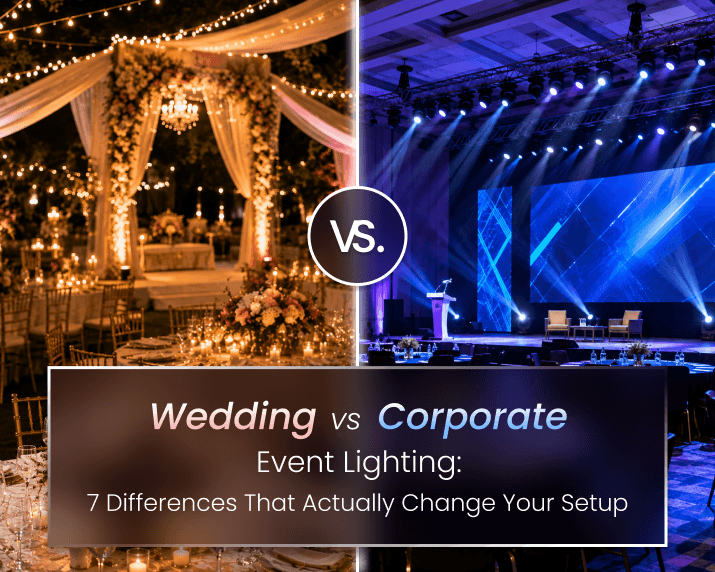
Pack up the lighting equipment from a Brentwood wedding and bring it to a corporate dinner in Encino the next night. You’d find the same bistro lights, the same uplights, the same pin spots. The gear is identical. But the two events are nothing alike.
What that equipment is being asked to do is completely different. That’s the part most guides skip over. It shapes every decision: where the lights go, what color temperature to use, and how the space gets divided.
Here are the 7 places where weddings and corporate events actually diverge, what that means for your setup, and where the two end up using the same approach anyway.
What Both Events Start With: The Shared Toolkit
Start with the equipment, because this is where people expect the difference and don’t find it.
Bistro lights (the warm overhead string lights you see at nearly every outdoor event) work for both. Uplights at tree bases or along perimeter walls add depth. Pin spots draw attention to specific elements like centerpieces or a speaker podium. If the property already has landscape lighting installed, that becomes the ambient base layer the event runs on top of.
The equipment stays the same. What diverges is the configuration, the color temperature choices, and what the space should feel like by the time guests are finishing their meals.

Difference 1: The Emotional Goal
The most fundamental difference between event lighting for weddings and corporate event lighting isn’t technical. It’s intentional.
A wedding asks lighting to do something deeply personal. The goal is warmth, intimacy, and the feeling that the space was assembled specifically for two people and everyone who showed up for them. Every fixture decision feeds that feeling. Harsh, bright light at a wedding reads as clinical no matter how expensive the setup is. Guests will sense it even if they can’t name what’s off.
Corporate event lighting has a different job. It needs to support a professional impression, keep branded elements visible, and make sure the space photographs well for the company’s use afterward. The goal at a product launch or client appreciation dinner is clarity and presence, not romance.
Every technical decision that follows flows from that difference.
Difference 2: Color Temperature
Walk into any outdoor event with well-chosen lighting and you’ll notice something feels right. That’s almost always color temperature at work, even if you couldn’t name it.
For outdoor weddings, 2700K to 3000K warm white is nearly universal. That amber quality reads as romantic and intentional. Bistro lights in this range cast a soft glow that flatters skin tones in photos and makes the whole outdoor setup feel like a well-lit restaurant rather than a backyard under task lighting. Worth knowing: a lot of what people describe as a “beautiful” outdoor event is mostly the right color temperature doing its job.
Corporate is different. Presentations, award ceremonies, and branded dinners need lighting that keeps text legible and faces visible at camera distance. That tends to sit between 3000K and 4000K. Warm amber might feel inviting, but it works against you when someone needs to read a company logo or follow a slide deck from across the patio.
If a property already has landscape lighting installed, the color temperature of that base layer matters too. Deep amber uplights on a corporate event can undercut the professional tone even if the event-specific lighting is well-calibrated. These things compound.
Difference 3: Branding vs. Atmosphere
A wedding doesn’t have a brand identity. It has an aesthetic, one chosen by the couple and reflected through florals, linens, and lighting, but there’s no logo to project and no palette that has to match a style guide. The brief is emotional, not visual standards.
Corporate lighting almost always involves a branding conversation that weddings never have. A company hosting a client reception in Pacific Palisades is going to ask about color-matching their brand palette, or whether you can project the logo somewhere visible. That’s a very different starting point than a couple choosing bistro lights because they liked the look at a restaurant.
This changes how lighting gets specified from the start. At a wedding, the first conversation is about what mood you want to create. Corporate briefs often start with brand color codes and work backward from there.
Honestly, the corporate brief is often easier. It has clear constraints. The wedding brief requires a lot more interpretation.
Difference 4: Static vs. Evolving Through the Night
A wedding reception has phases. The cocktail hour calls for one setup: relaxed, bright enough for guests to find each other and navigate the space. Dinner shifts the feeling toward something softer. The dancing portion of the night calls for more energy.
Getting the lighting right for a wedding means designing for that shift from the start. Dimmable zones mean the same backyard can feel relaxed at cocktail hour and charged up by the time the first dance rolls around. That transition is what actually separates a memorable setup from a serviceable one.
Corporate events tend to be more static. A mixer or a dinner reception for 80 guests might run from arrival through dinner at one consistent setting. If there’s a presentation moment or an award ceremony, there may be a single transition (brighter on the stage, dimmer everywhere else), but it’s rarely the layered choreography a wedding requires.
Still, don’t assume corporate events are always simpler to light. The expectation for a polished, professional result is every bit as high. It’s a different kind of polish.
Difference 5: Backyard Wedding Lighting Requires Different Positioning
Indoor venue guides don’t translate well to backyards. There are no rigging points, no dedicated power runs, and no floor plan designed for large gatherings.
A backyard wedding in Studio City or Encino is working with residential landscaping, mature trees that may or may not sit where you’d want them, a patio that wasn’t designed for a seated dinner for 100 guests, and a property line that means neighbors have real opinions about what’s happening at 10 PM. What people don’t realize is how much of backyard event lighting comes down to working around existing conditions rather than designing from scratch.
Backyard wedding lighting ideas that actually work tend to layer overhead bistro lights with ground-level uplighting on existing trees and perimeter shrubs, then use the property’s existing landscape lighting as the ambient base. The result is a layered setup that makes the space feel intentional without requiring anything permanent.
Corporate backyard events (a client reception, a team dinner, a product preview party) prioritize a different kind of flow. Guests are standing and moving through the space more than at a seated wedding. Lighting needs to define zones clearly: the bar area, the conversation area, the food station. Bistro lights still work well overhead, but they’re configured to guide circulation rather than create an intimate atmosphere.

Difference 6: Setup Timeline and Coordination
A wedding has one chance to be right. The setup window is usually the morning of the event. The stakes are high, and there’s no acceptable version of “close enough.”
That changes how a professional event lighting company approaches the site visit, the equipment check, and the day-of timeline. Every connection gets verified before the crew leaves. Backup equipment comes on the truck. The team doesn’t sign off until the client has walked the space and confirmed it looks right.
Corporate events often have more flexibility. They’re frequently planned with longer lead times, may repeat at the same location, and are typically part of a larger vendor coordination process managed by a planner or facilities contact. The stakes are professional rather than once-in-a-lifetime.
This distinction matters when you’re budgeting for labor. Wedding lighting setups carry a higher service standard because the event demands it. The cost reflects it.
Difference 7: Budget Approach
Weddings are a one-time investment. There’s no need to amortize the lighting cost across multiple events. This tends to push couples toward higher-end setups they wouldn’t consider for a recurring event. If the bistro lights are going up once and this is the night they’ve been planning for years, the upgrade to denser strand coverage or custom pole placement is easier to justify.
Corporate events often repeat. A company that hosts a quarterly client reception or an annual party is thinking about per-event cost across a relationship that might run three or four years. That changes the math considerably. A setup that works well, photographs well, and can be deployed reliably matters more than a one-night maximum-impact installation. Either way, the right question is what you’re optimizing for.
At Elevated Seasons, our bistro lighting installations start at $1,500 for simpler patio setups and scale to $2,500 for medium backyard installations, $3,500 for larger entertainment-grade setups, and $4,500 for premium estate properties. The pricing doesn’t change whether the event is a wedding or a corporate dinner. What changes is the configuration, the coordination requirements, and how much lead time goes into the site design.
For a detailed breakdown of what each tier includes, see our bistro lighting pricing page.
Where Wedding and Corporate Lighting Overlap: Bistro Lights
Despite the seven differences above, one fixture type works reliably for both formats: bistro string lights installed overhead.
Warm bistro lights over an outdoor dining or gathering area create the effect of a ceiling in open air. They define the event boundary, add ambient warmth, and photograph well regardless of the event type. A wedding benefits from them, and so does a corporate reception or a backyard birthday party in Calabasas.
The setup around them is what changes. Wedding bistro lights get paired with softer uplighting and positioned with the florals and decor in mind. The look is layered and warm. Corporate setups tend toward cleaner perimeter lighting with everything designed to put the branded elements in the foreground.
Bistro lights are almost never the wrong call for an outdoor event. The question is what goes around them.

How Elevated Seasons Approaches Event Lighting in Los Angeles
The first thing we ask any client calling about outdoor lighting for a backyard event is simple: what does this night need to feel like when people are leaving?
The answer to that question shapes everything else. A wedding and a corporate reception give completely different answers, and from there the entire setup process branches in a different direction. The follow-up questions change. The configuration takes a different shape. How we coordinate with other vendors changes too.
What stays the same is how we approach the site. We look at what’s already there: existing landscape lighting, tree canopy, hardscape surfaces, and power access. We build from that rather than ignoring it. A property with well-designed landscape lighting already has the ambient base layer done. The event lighting goes on top of it, not in competition with it.
to discuss your event and get a walkthrough of what the right setup looks like for your specific outdoor space.
Frequently Asked Questions About Wedding vs. Corporate Event Lighting
What is the main difference between wedding and corporate event lighting?
The core difference is the goal. Wedding lighting is designed to create warmth, intimacy, and an emotional atmosphere that evolves through the evening from cocktail hour through the reception. Corporate event lighting prioritizes clarity, branding, and a professional impression that photographs well and supports the company’s image. Both use similar equipment, but the configuration, color temperature, and intensity are calibrated differently based on what the event is trying to accomplish.
What kind of outdoor lighting works best for a backyard wedding in Los Angeles?
Bistro string lights installed overhead are the most versatile starting point, typically combined with warm white uplighting on existing trees or perimeter shrubs and landscape lighting as the ambient base layer. In LA, where backyard weddings often take place on residential properties with mature landscaping, working with the existing outdoor features rather than trying to hide them produces the most natural and flattering results. Color temperature in the 2700K to 3000K range is standard for wedding settings.
How much does outdoor event lighting cost in Los Angeles?
Bistro lighting installations at Elevated Seasons start at $1,500 for smaller patio setups and scale through $2,500 for medium backyard configurations, $3,500 for larger entertainment-grade properties, and $4,500 for premium estate installations. The cost depends on the size of the space, the mounting approach, and how complex the layout is. Corporate events and weddings are priced the same way: the event type doesn’t change the installation cost, though setup coordination and timeline requirements may affect labor.
Can the same lighting setup work for both a wedding and a corporate event?
In most cases, yes. A well-designed bistro lighting installation on a residential or event property can serve both formats. The difference is in the details around it: the color of the uplighting, the intensity of the ambient light, whether branding elements are incorporated, and how the space is zoned. A setup that was installed for a wedding can absolutely be used for a corporate reception the following year. The base infrastructure is the same.
Do I need a professional for backyard event lighting, or can I rent the equipment myself?
Equipment rentals are available, but the installation quality typically shows. The difference between a DIY bistro light setup and a professionally installed one is usually apparent in how the lights span between anchor points, how evenly the strands are distributed, and whether the overall setup has a deliberate design or a functional one. For a wedding or a corporate event where the space will be photographed and the impression matters, professional installation is worth the cost. For a casual backyard gathering, rentals work fine.
