

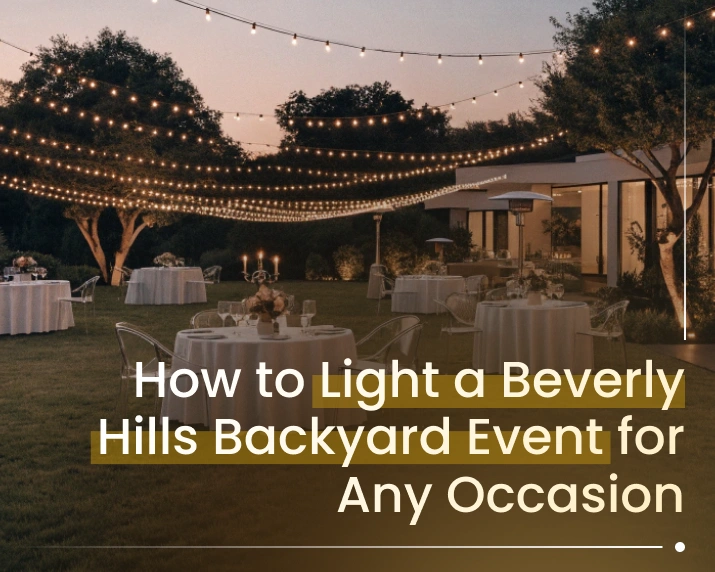
Knowing how to light a Beverly Hills backyard event is a different problem than it looks from the outside. Most of the properties here already have permanent landscape lighting installed: path lights along the entry, uplights on mature trees, in-ground well lights around the pool. That system works well on a normal evening. But an event is not a normal evening.
The dining terrace is suddenly seating forty people. The motor court is handling arriving guests at 7 PM and departing guests at midnight. The bar station is in a corner of the yard that never needed task lighting before. And the string lights someone hung over the pergola are nice, but they don’t help anyone find the path to the pool house.
Backyard event lighting ideas for a Beverly Hills property have to start with what’s already there and work out from that point. This guide covers how to approach the lighting in zones, how to layer temporary fixtures over your permanent system, and how to handle the practical realities of power and timing.
Why Existing Landscape Lighting Matters for Event Planning
The instinct when preparing for an event is to start fresh: rent everything, set it up the day before, take it all down Sunday morning. For most of the yard, that’s unnecessary. Your permanent system already handles the ambient layer, defines the property edges, and provides path safety lighting. Those are real jobs that don’t need to be duplicated.
What the permanent system doesn’t do is provide task lighting for zones that see unusual activity during an event: the dining terrace, the food station, the motor court. These are areas that don’t normally require focused illumination, so the permanent installation was never designed to address them. That’s where temporary event lighting does its work.
Understanding this distinction before you start ordering rental equipment will keep the whole effort from getting out of hand. In practice, a well-designed permanent system means you’re supplementing roughly three or four specific areas rather than lighting the entire property from scratch.
Lighting Zones for a Beverly Hills Backyard Event

Beverly Hills properties have a fairly consistent set of functional areas. Getting the zones right means thinking about each one separately, because they need different types of light for different reasons.
Entry and Motor Court
This is where guests form their first impression, and it’s consistently under-lit for event use. Your permanent path lights handle the walkway itself. The motor court, though, typically has no lighting designed for the volume of foot and vehicle traffic an event generates. Battery-powered stake lights positioned along the motor court perimeter, or portable LED uplights pointed at the entry gate, give arriving guests enough light to navigate safely without any electrical work. They come down the next morning.
If you have outdoor security lighting installed at the perimeter, check whether it can be switched to stay-on mode for the event’s duration rather than cycling on motion sensors. Motion sensors trip constantly with guests moving through the area, which creates a flickering effect that reads as a maintenance problem rather than intentional design.
Dining Terrace
Table lighting is the single most important zone to get right. The most reliable solution at this scale is warm white string lights, festoon-style, hung between fixed anchor points at eight to ten feet above the table surface. They’re easy to source and install in an afternoon, and they run off any existing outdoor outlet without trade work. Height matters here. Below eight feet and they feel like a tent; above twelve and they stop providing useful light at table level.
Your permanent uplights on the terrace perimeter can stay active during the event. They provide surrounding ambient light that keeps the space from feeling like a stage with dark edges.
Bar, Food Station, Pool Deck, and Garden Paths
The bar and food station need task lighting. People need to actually see what they’re reaching for. Portable battery-powered LED spotlights you can aim precisely are the easiest answer here. Position them at 2700K to 3000K warm white, slightly above eye level, to illuminate the surface without creating glare.
Your existing pool lighting handles the water. The deck benefits from a few portable LED uplights aimed at surrounding plantings, which gives the area visual presence without competing with the pool’s glow. Garden paths with permanent path lights installed are mostly covered. If the event will send guests along paths that don’t normally see foot traffic at night, a few temporary stake lights fill those gaps without changing anything in the permanent system.
Layering Temporary and Permanent Lighting Together
The question comes up every time: do you turn off the permanent system when the event lighting goes in? The short answer is no. The two systems are doing different jobs at different heights and intensities.
Your permanent uplights, path lights, and well lights are positioned relative to the plantings and architecture. That calibration took work to get right. Temporary string lights over a dining table don’t compete with uplights on a mature oak because they’re operating at different levels, aimed in different directions. Running both together gives you depth. Running event lighting alone in a yard designed for landscape lighting tends to feel flat.
The one coordination point worth thinking about is color temperature. According to the Illuminating Engineering Society, maintaining consistent color temperature across a layered lighting system is what makes a space feel cohesive rather than assembled. If your permanent system runs at 2700K warm white, your temporary event lighting should match. Cool white festoon lights against warm white uplights creates a visual split that draws attention in the wrong direction.
Most modern transformers have a dimming capability. For events, running the permanent system at 60 to 70 percent of its normal output lets the event lighting carry the closer-range task work without the ambient system overwhelming it. If yours doesn’t dim, that’s usually fine. The event lighting itself fills enough of the mid-range that the full permanent output doesn’t become a problem.

Power Planning for a Large Beverly Hills Property
Beverly Hills properties are large. A catered event for sixty-plus guests running string lights, bar lighting, ambient fixtures, and a DJ setup is going to push more electrical load than a normal residential evening. This deserves attention before the day of the event, not the morning of.
Start by identifying where your outdoor circuits are and what each one is rated for. Most residential properties have two or three outdoor circuits. String lights over a large terrace can pull eight to twelve amps depending on length. A DJ or AV setup can pull fifteen amps or more. Running that off a single 20-amp circuit trips the breaker during the worst possible moment of the event. Knowing which outlets are on which circuits before load day, not during setup, avoids most of these problems.
For events with significant AV or lighting rental equipment, a small generator dedicated to the event load is often the cleanest solution. It keeps the event circuits entirely separate from your home’s electrical system and your permanent landscape lighting. Rental companies that supply event fixtures can usually supply a properly-sized generator as well, and coordinating both through the same vendor simplifies the logistics considerably.
According to the U.S. Department of Energy, LED fixtures use at least 75 percent less energy than incandescent equivalents. For outdoor party lighting in Beverly Hills during July or August, when ambient temperatures are still in the 80s at 9 PM, LED fixtures also generate significantly less heat. That matters both for comfort near the fixtures and for anything attached to rigging running for four to five hours.
The Day-to-Night Transition
Most Beverly Hills backyard events start before dark. A typical dinner party or small reception begins at 6 PM and runs well past sunset, which means the lighting plan has to work in three conditions: late afternoon daylight, the 45-minute transition around golden hour, and full evening after 8 PM.
String lights and festoon fixtures are invisible in daylight. They don’t contribute anything until the sky darkens. That’s expected behavior, not a design flaw. During the transition period, uplights and path lights from the permanent system carry most of the visual work. The event lighting starts to assert itself naturally as the sky dims.
Worth doing: bring the temporary event lighting up at reduced intensity during the transition rather than switching it on at full output all at once. Most LED fixtures dim without color shift. Starting at 50 percent output around 6:30 PM and gradually increasing through golden hour makes the shift feel designed rather than sudden.
How Elevated Seasons Approaches Event Lighting in Beverly Hills

Our Beverly Hills landscape lighting projects cover design and full installation for residential properties throughout LA County, and event lighting questions come up regularly because our clients use their yards for exactly this kind of occasion.
When we’re involved in event lighting setup, the starting point is always a walkthrough of the existing system: what it covers well, where it leaves gaps, and what the specific event needs are. A property where the permanent system was designed with future event use in mind is a short walkthrough. Additional outdoor circuits, built-in anchor points for overhead rigging, and transformer capacity designed to accommodate supplemental loads were already part of the plan.
For outdoor party lighting in Beverly Hills, the combination that works most consistently is the permanent system handling ambient and path safety, portable task lighting for the bar and food zones, and string lights for the primary dining area. Our coastal landscape lighting work in Pacific Palisades shows how layered systems handle varied use cases across larger properties.
If you’re thinking about event lighting and also considering updates to your permanent installation, there’s a real benefit to approaching them together. The permanent system serves you every night. Event-specific additions extend what it can do on the occasions that need more. A few choices made at installation time, like oversizing transformer capacity and adding outdoor circuit locations near the dining terrace, add very little cost during the build and make every future event easier to set up.
to discuss your backyard event lighting needs and schedule a site walkthrough.
Frequently Asked Questions About How to Light a Beverly Hills Backyard Event
How do I light a Beverly Hills backyard event without an electrician?
Battery-powered fixtures handle most event-specific needs without any electrical work. Portable LED spotlights for food and bar stations, battery-powered stake lights for the motor court and secondary paths, and string lights connecting to existing outdoor outlets are all options that install quickly and require no licensed trade work. The permanent landscape system handles ambient safety lighting. The realistic limit of this approach is scale: for a large event with significant AV equipment or extensive overhead rigging, a rental company or licensed electrician for temporary circuit work starts to make more sense.
What are the best backyard event lighting ideas for a Beverly Hills property?
Start with what the property already has. Permanent uplights, path lights, and pool lighting define the space and provide the ambient layer. Layer on string lights for the dining terrace, task lights for the bar and food station, and supplemental stake lights for high-traffic paths and the motor court. Color temperature consistency matters more than people expect: warm white at 2700K to 3000K across all temporary fixtures, matching whatever color your permanent system runs. For choosing outdoor patio lighting types, that guide covers fixture selection in more detail.
How much does outdoor party lighting in Beverly Hills typically cost?
For a self-managed setup covering a dining terrace, bar station, and motor court, equipment runs roughly $400 to $900, depending on the scale of the event and whether you’re sourcing through a party rental company or purchasing outright. For professionally managed landscape lighting for events with design input, installation, and removal, pricing depends heavily on scope. Landscape lighting designers who already know the property can often scope event needs and provide pricing in a single walkthrough.
Should I use temporary event lighting or upgrade my permanent landscape lighting?
For a one-time event, temporary lighting is the practical answer. For a property that hosts several events a year, it’s worth thinking about what permanent additions would reduce the temporary setup required each time. Additional outdoor circuit locations near the dining terrace, oversized transformer capacity, and built-in anchor points for overhead rigging add very little cost during an installation and make every subsequent event easier to light. Ask your lighting contractor what those additions would add to the project scope before committing to a permanent design.
What should I know about outdoor lighting for a backyard event or wedding in Beverly Hills?
Safety lighting along paths and through the motor court should stay on for the full event duration and through guest departure. Motion-sensor fixtures on the permanent system should be set to stay-on mode, not cycling, for the event’s duration. For late-running events, the string lights and task lighting that worked for dinner continue working through the evening. According to ENERGY STAR, LED outdoor fixtures maintain consistent output across their rated lifespan, so fixtures that looked right at 7 PM still look right at midnight. What changes is the surrounding context: once ambient twilight is fully gone, the event lighting has to carry more of the visual work on its own.
