

Most homeowners spend weeks on the turf product itself: pile height, blade shape, color variation, backing material. The infill question comes up on installation day, usually when the installer asks what you want, or when they use whatever’s standard for that job. You nod. The project wraps up looking exactly right, and nobody gives infill another thought until the yard holds heat in a way that feels off, or the pet area develops a smell that hosing it down won’t fix.
Infill is the granular material worked into the pile between the grass blades. It keeps fibers upright, but it’s also doing things most people don’t ask about: controlling how fast water drains through, how hot the surface gets on a July afternoon, whether pet odor builds up over time or stays manageable. The choice between artificial turf infill types is worth more attention than it usually gets. Pick the wrong one and some of those problems are hard to correct without pulling the turf back up.
What follows breaks down each main type: what it does well, where it falls short, and which situations call for it.
What Is Artificial Turf Infill and Why Does It Matter?
Artificial grass fibers attach to a backing material. Without something filling the space between the blades, they’d lie flat from installation day forward. Infill is the granular material spread across the surface during install, then worked down into the pile with a power brush. Most people understand that part. What doesn’t get as much attention is everything else it’s doing: holding the backing in place so it doesn’t shift, controlling how fast water drains through, and changing surface temperature and odor behavior depending on what the material actually is.
It also affects long-term maintenance in ways that aren’t obvious until a few years in. Some infill materials compact over time and need refreshing. Others hold up for the lifetime of the turf without significant settling. Get it right at the start and the infill runs quietly in the background for years. Get it wrong and the fix usually means pulling turf up. The base preparation also connects here: how infill drains depends partly on what’s underneath it, so those two decisions aren’t completely separate.
The Three Main Artificial Turf Infill Types
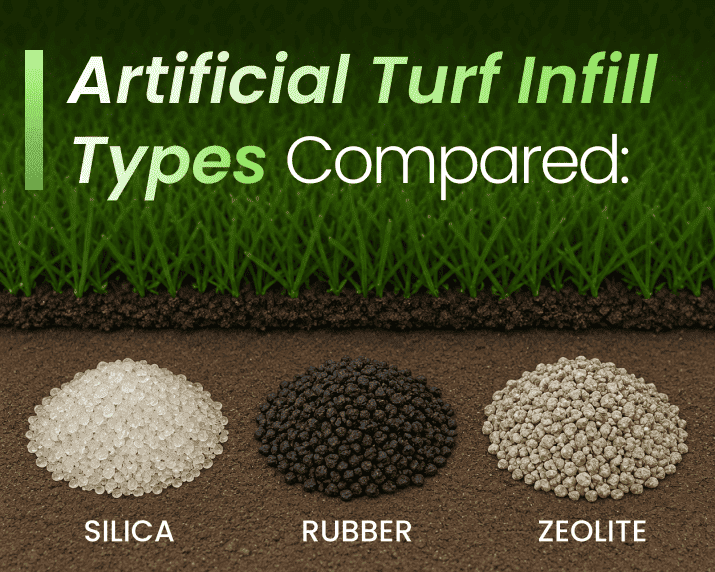
Three materials cover the overwhelming majority of residential installations: silica sand, rubber (in several forms), and zeolite. There are also organic options like cork and coconut fiber, and proprietary coated-sand products like Envirofill and T-Cool. But honestly, those three are what most LA homeowners actually encounter when it comes time to make the call.
No single infill type works for every situation. Each one makes a different trade-off between cost, heat load, odor control, cushioning, and how much maintenance it’ll need in year three or year five. Understanding those trade-offs before installation is the whole point.

Silica Sand Infill
Silica sand is the baseline, and it’s the most common infill in residential turf installations largely because it’s the least expensive and handles the core jobs reasonably well. It keeps fibers upright, adds weight, and drains quickly. For a front yard or backyard lawn with no pets and moderate foot traffic, it does the job without much to complain about.
Heat is where it falls short. On a July afternoon in Arcadia or the San Fernando Valley, a silica-infilled turf surface in full sun can reach 140 to 160 degrees Fahrenheit. That’s hot enough to cause burns on bare feet and paws, and it’s the main complaint about older synthetic turf installations in LA’s inland neighborhoods. Properties closer to the coast in Santa Monica or Culver City are less affected since marine layer and lower ambient temperatures keep surface temps more manageable. But any property with southern or western exposure in a warmer inland zone will feel this in summer, and it catches people off guard more often than it should.
Silica sand also doesn’t do anything for odors. It’s inert. Urine from pets will drain through, but the ammonia compounds aren’t absorbed or neutralized. In a yard with regular pet use, a silica-only infill will develop odor problems over time that grooming and hosing down won’t fully fix.
For a landscape installation with no pets and decent shade coverage, silica sand is a cost-effective choice. It’s the infill included in the Essential Series at $9.50/sq ft. Where heat or odor is a factor, it’s worth upgrading.
Rubber Infill: Crumb Rubber, TPE, and EPDM
Rubber infill comes in three main forms. Crumb rubber is shredded recycled tire material, sized for turf infill. It’s been the standard on athletic fields and school playgrounds for decades, mainly because of its shock absorption. TPE (thermoplastic elastomer) and EPDM (ethylene propylene diene monomer) are manufactured materials, not recycled, and they cushion similarly without any tire content. That distinction matters to clients who’d rather not think about the health question at all.
Crumb rubber’s main advantage is shock absorption. On a residential scale, that pays off in play areas and anywhere kids are regularly falling or running around. Rubber is also denser than sand, so it stays in place better under heavy use and doesn’t migrate out of the pile as easily.
But the health question around crumb rubber is real and worth understanding before committing to it. The EPA and CDC conducted a multi-year Federal Research Action Plan on tire crumb rubber exposure. Measured chemical exposures in study populations fell below levels associated with health concern, according to the EPA tire crumb exposure characterization report, though that research focused on athletes with intense physical contact. For a residential backyard, exposure levels are considerably lower. Still, some homeowners want to avoid the question entirely, and that’s a perfectly reasonable position.
TPE and EPDM don’t contain recycled tire content. EPDM handles LA’s UV load well since it’s specifically designed for prolonged outdoor exposure and doesn’t break down from sun the way crumb rubber can over years. TPE is fully recyclable at end of life. Both cost more than crumb rubber, but not dramatically so on a typical residential project.
The heat problem with rubber is more pronounced than with silica sand. Rubber in direct sun can reach surface temperatures 20 to 30 degrees above ambient air temperature. If the turf will be used by young kids or dogs during summer afternoons, that’s a real heat concern for any inland LA neighborhood. Shading the surface or incorporating a cooling infill layer is worth considering when rubber is the primary infill.
Zeolite Infill: The Best Option for Pet Areas
Zeolite doesn’t work by masking odors. The mineral physically traps ammonia molecules inside its porous structure and holds them there. Rain or a hose-down flushes the captured compounds out and resets the capacity. That’s the actual mechanism, and it’s genuinely different from what most infill materials do with pet waste, which is essentially nothing. Natural clinoptilolite zeolite achieves over 90% adsorption efficiency for ammonia and other odorous compounds, according to a peer-reviewed study published in Materials.
It comes from volcanic deposits: a naturally occurring mineral with a lattice structure full of microscopic pores. ZeoFill is the most common branded product for residential turf applications. That same porosity holds onto moisture a little longer than sand does, which means the surface runs somewhat cooler. It’s a modest difference, not comparable to dedicated cooling infills, but real and consistent.
The practical limitation is cost. Zeolite runs $0.60 to $1.20 per pound at retail, compared to $0.05 to $0.15 for silica sand. At 1.5 to 2.5 pounds per square foot, that gap adds up fast on any full installation. Most installers handle this by layering: silica sand as the base, zeolite on top at about 30 to 40% of the total. You capture most of the odor-control performance without paying full zeolite rates across the whole job.
Zeolite doesn’t provide meaningful cushioning, so for areas where shock absorption matters, like kids’ play areas or putting greens, it’s not the right primary infill. In mixed-use yards where one section sees pet traffic and another sees active play, blending infill types by zone makes more sense than one material across the whole surface.

How LA’s Climate Affects Your Infill Choice
Most turf manufacturers test in controlled conditions that don’t come close to what LA actually puts surfaces through. Take October: a single week can run 60-degree marine-layer mornings on the westside, 95-degree Santa Ana afternoons inland, and six inches of rain over a weekend. Those swings are wider than any fixed climate zone rating captures, and they stress infill materials in ways that tend to show up a few years in rather than immediately.
A few LA-specific realities are worth factoring in:
Summer surface heat runs hottest between June and October. Silica sand runs hot; rubber runs hotter. Coated sand and zeolite blends perform better but still get hot in full afternoon sun. If you’re picking infill for an unshaded backyard in the San Gabriel Valley or the West Valley, surface temperature should be a primary variable, not an afterthought.
The Santa Ana wind effect matters too. Hot, dry Santa Ana conditions pull moisture from everything, including infill. Silica sand shifts a bit during sustained Santa Ana wind events, and zeolite’s moisture-retention benefit largely disappears when humidity drops to single digits. Refreshing the surface with water after a Santa Ana stretch helps both.
Coastal and inland properties don’t perform the same way. Homes in Brentwood, Pacific Palisades, or Marina del Rey benefit from ambient cooling through most of the summer. Properties in Encino, Glendale, or Burbank face the full summer heat load. Infill that performs adequately in a coastal installation may not hold up the same way a few miles inland. And LA’s winter rain, when it arrives, tends to come fast. A properly installed drain base handles this regardless of infill type, but the ideal pile height and thickness of the turf affects how much infill it holds and how drainage performs season to season.
What Infill Do Elevated Seasons Clients Use?
When a client contacts Elevated Seasons about a turf installation, the infill recommendation comes after understanding how the yard is used, who’s using it, and what the property’s sun exposure looks like. The infill question and the product question aren’t separate decisions.
For standard residential lawn areas with no pets and moderate foot traffic, silica sand or a coated sand blend handles the job at the right cost point. The Essential Series at $9.50/sq ft includes silica sand infill and covers most front-yard and low-traffic backyard scenarios.
For higher-traffic areas or properties where cushioning matters, the Performance Series at $11.75/sq ft includes premium infill selected for that project. On many of these installs, that’s a rubber-free coated sand or TPE blend rather than crumb rubber, depending on what the client prefers and what the sun exposure looks like.
For pet-focused installations, the Signature Estate Series at $15.50/sq ft includes pet-friendly and antimicrobial infill options: typically a zeolite blend or proprietary antimicrobial coated sand that handles odor without the heat load of rubber. It also includes a 5-year warranty and advanced drainage integration.
If you’re also working through replacing a lawn with turf or sizing up the artificial turf installation cost, infill choice feeds directly into both of those conversations.
When to Replace or Refresh Infill
Infill doesn’t last forever, and the timeline varies more than most people expect. Silica sand compacts over time as foot traffic and weather press it down. When a turf surface looks flat or matted even after brushing, compacted infill is usually the reason. A professional re-application can revive a surface that looks worn but is structurally sound.
Low-traffic front yards might go five to eight years before the infill needs refreshing. Backyards with dogs, kids, and regular use often need it at the three to four year mark. Pet areas using zeolite benefit from periodic partial replacement of the top layer as the mineral’s adsorption capacity gets used up. Plan for a partial top-up every two to four years depending on the size and number of the dogs.
The practical test is simple: brush the turf thoroughly and see whether the fibers spring back upright. If they don’t, the infill has compacted and a re-application is the right next step rather than tolerating a flat surface. Staying current on artificial turf maintenance extends both the infill’s effective life and the overall system.
Rubber infill that’s been in place for many years can migrate out of the pile. Dark granules appearing on hardscape edges or collecting at drains usually mean rubber infill is on the move. The system hasn’t failed, but a top-up is overdue.
What About Organic Infill Options?
Cork and coconut fiber infills have gained traction for clients who want to avoid rubber entirely. Both are biodegradable and have a lower heat load than rubber. In practice, the limitation is durability. Organic materials break down faster than mineral or synthetic alternatives, particularly under LA’s combination of UV exposure and intermittent heavy rain. A cork infill that performs well in a cooler, wetter climate may need refreshing more frequently in Southern California’s conditions.
For clients who prioritize environmental impact above other factors, organic infill is a viable option. For most LA residential projects, silica sand, zeolite blends, and TPE or EPDM cover the range of performance requirements with better durability and predictable maintenance cycles over the turf’s full lifespan.

How Elevated Seasons Approaches Artificial Turf Infill
Before selecting infill for a project, we look at three variables: use pattern, sun exposure, and the turf product itself. Some turf fibers are designed for specific infill types and perform poorly with others. That detail matters more on premium products where the fiber quality is worth protecting.
We also walk the property. A backyard in Altadena that gets afternoon shade from a mature oak has a different heat profile than a flat open lawn in Northridge with no shade at any point during the day. Infill that handles one situation well may need to be adjusted for the other. Our is artificial turf worth it in Los Angeles guide covers how those environmental factors affect the broader installation decision.
What you’re asking the surface to do matters as much as the infill specs. A front yard used for curb appeal and light foot traffic gets a different recommendation than a backyard where two large dogs spend most of the day.
to discuss infill options for your property. We’ll review the site conditions and give you a clear recommendation before anything is specified.
Frequently Asked Questions About Artificial Turf Infill Types
What is the best infill for artificial grass with dogs?
Zeolite is the strongest performer for pet areas. It’s a natural volcanic mineral that captures ammonia at the molecular level rather than masking the odor. Most professionals apply it as a top layer over a silica sand base, which gets most of the odor-control benefit without paying full zeolite cost per square foot. In a high-pet-traffic area, expect to partially refresh the zeolite layer every two to three years as the mineral’s capacity gets used up. ZeoFill and similar branded products are sized specifically for turf infill and widely available through installers.
Does rubber infill get too hot for pets and kids in Los Angeles?
For inland LA neighborhoods, yes, it can be a real issue. Rubber infill absorbs more heat than any other common infill type. On a hot afternoon in Woodland Hills or Covina, rubber-infilled turf can run 20 to 30 degrees above ambient air temperature at the surface. Silica sand runs 15 to 25 degrees above ambient. Coated cooling infills and zeolite blends run lower than both. If the installation will see kids or dogs during summer afternoons, rubber as the sole infill creates a heat concern worth thinking through before committing. Shading the surface, watering it before use, or choosing a lower-heat infill type are the practical alternatives.
How much does artificial turf infill cost?
Silica sand runs roughly $0.05 to $0.15 per pound. TPE and EPDM rubber infills run $0.50 to $1.00 per pound. Zeolite runs $0.60 to $1.20 per pound. At 1.5 to 2.5 pounds per square foot, the difference between silica sand and a zeolite or TPE install on a 500 sq ft yard can be several hundred dollars in material alone before labor. At Elevated Seasons, infill is included in the installed price rather than quoted separately: the range runs $9.50 to $15.50/sq ft depending on the series.
Is crumb rubber infill safe for residential use?
The EPA’s Federal Research Action Plan study found that measured chemical exposures from tire crumb rubber fell below levels associated with health concern. That research focused on athletes on soccer fields with intense physical contact, which is a significantly higher exposure scenario than a residential backyard. Homeowners who’d rather not think about it can choose TPE or EPDM, which offer comparable cushioning without recycled tire content. The EPA tire crumb research is the most thorough independent evaluation available if you want to read it in full.
How often does artificial turf infill need to be replaced?
It depends heavily on how the yard gets used. Low-traffic front yards can go five to eight years before the infill compacts enough to affect appearance and drainage. High-use yards with pets or children typically need a re-infill at three to four years. Zeolite top layers in pet areas wear out faster since the mineral’s odor-control capacity gets consumed over time. Plan for a partial top-up every two to three years in heavy pet areas. Test it by brushing the turf: if the fibers don’t stand back up, a professional re-application is the right next step.
What types of artificial grass work best with zeolite infill?
Zeolite pairs well with most residential products, but it performs best with turf that has an open-weave backing and adequate drainage perforations. Tighter-backed turf with fewer drainage holes slows the flush cycle that refreshes zeolite’s odor-control capacity after rain or hosing. When selecting both the types of artificial grass and the infill, reviewing them together with the installer ensures the backing’s drainage profile matches the infill type you’re specifying.
